When most people think about Abuja, they picture Maitama, Wuse, and Asokoro, manicured streets, fibre-optic offices, and 5G-ready mobile networks. But Abuja is not one city. It is six Area Councils, and five of them, Bwari, Kuje, Kwali, Gwagwalada, and Abaji - tell a very different story. In these communities, where the majority of the FCT's population actually lives, internet access is not a convenience. It is a closed door.
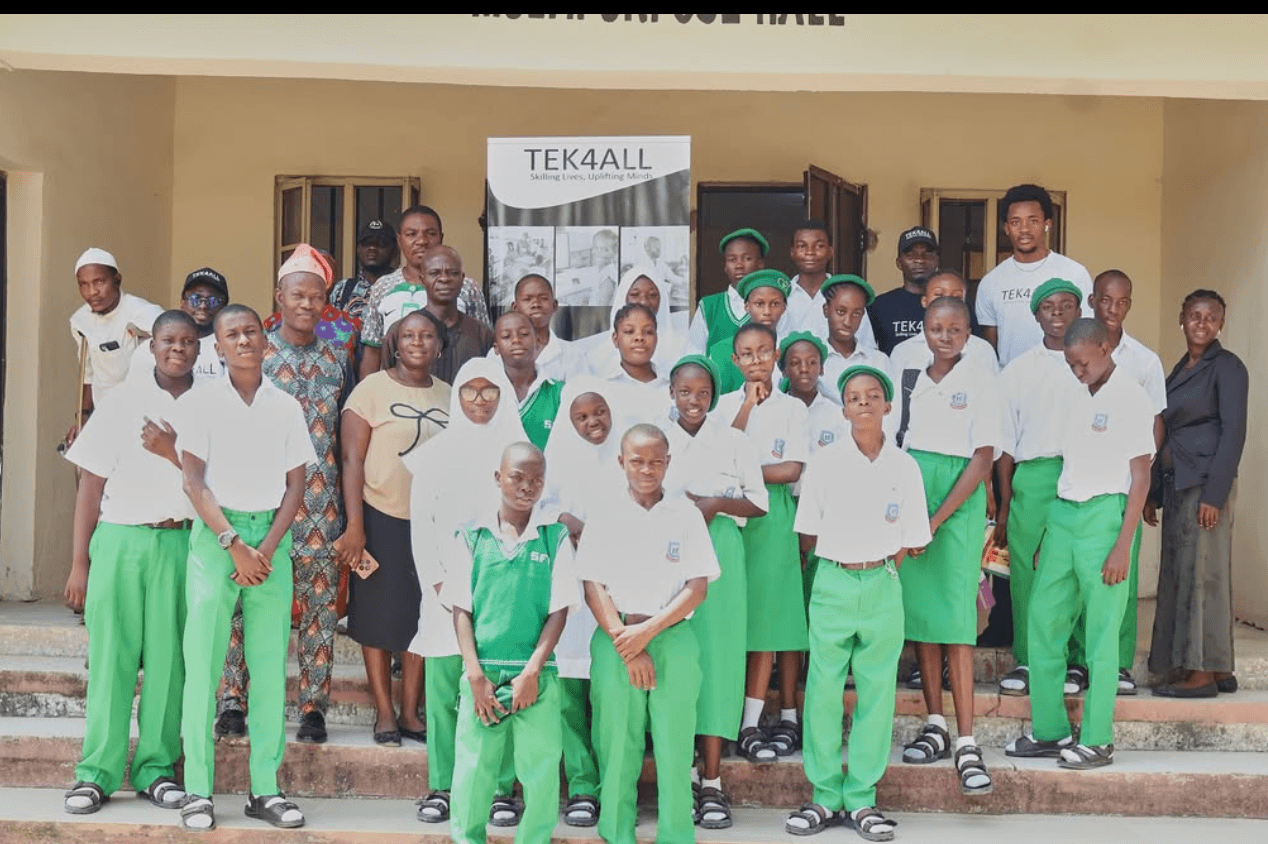
At Tek4All, our field engagement has taken us into schools, youth centres, and community spaces across peri-urban and rural Abuja, and the pattern repeats itself everywhere we go. We meet secondary schools with computer labs that have had no internet connection for years, sometimes since they were built. We walk into youth centres where a single 4G router is meant to serve forty young people, throttled to the point of uselessness by ten in the morning. We talk to teachers who have heard of ChatGPT, Khan Academy, and Coursera but have never been able to load any of them on a school device. And we meet bright, ambitious students who own smartphones but spend their entire monthly data budget, often less than two thousand naira, on WhatsApp and social media, because the educational platforms that could actually change their lives are too data-heavy to open. This is not a story about poverty of aspiration. It is a story about poverty of infrastructure.
Nigeria today has roughly 103 million internet users, but national averages hide the truth. The Nigerian Communications Commission's own data shows that broadband penetration is concentrated in urban centres, while rural and peri-urban areas across the country remain dramatically underserved. In the FCT specifically, the gap between Phase 1 districts and the outer Area Councils is one of the starkest in Nigeria. When we talk about "the AI revolution" or "the future of work," we are talking about a future that requires bandwidth. And when nearly half of Abuja's young people cannot reliably load a webpage, that future is being built without them.
This matters more now than it ever has. We are living through the most consequential technology shift in a generation, and AI tools are already reshaping how people learn, work, build businesses, and access opportunity. Every month that a young person in Kuje or Kwali cannot meaningfully access these tools is a month they fall further behind a peer in Maitama, or in Lagos, or in Nairobi, or anywhere else in the world. The digital divide does not stay still. It compounds. A student who cannot access AI-powered learning today will become a graduate who cannot compete tomorrow. A teacher who cannot access modern teaching resources today will train a generation of students with outdated knowledge. This is not a problem we can solve comfortably over five or ten years. The window is now.
At Tek4All, we are working at three layers of this problem. The first is direct programming, our digital literacy and AI education initiatives bring training, devices, and connectivity into schools and youth centres across the FCT, meeting young people where they are rather than waiting for them to come to us. The second is partnership building. We are coordinating action rather than duplicate effort, because the digital divide is too big for any single organization to close alone. The hard truth is that closing this divide requires three things working together: affordable connectivity, accessible devices, and meaningful digital literacy. Take any one of those away and the other two collapse.
So this is a call to everyone reading this. If you are a school administrator in Bwari, Kuje, Kwali, or Gwagwalada, talk to us, we want to understand what your students need. If you are a telecom operator, an ISP, or a technology company with an inclusion mandate, the outer Area Councils of the FCT are where your impact will be largest, and we can help you find the right communities and partners. If you work in policy or government, Abuja's outer Area Councils are not "future infrastructure projects", they are present-day citizens being left out of the digital economy your strategies depend on. And if you are simply someone who cares about whether the next generation of Nigerian innovators comes from every corner of this country, not just two postcodes in Maitama, then share this post, start the conversation, and join us. The silent divide stays silent because we let it. It is time to start naming it, measuring it, and closing it.
Tek4All is a digital inclusion and AI education NGO headquartered in Abuja, Nigeria. To partner with us, support our programmes, or learn more, reach us at impact@tekforall.org or visit tekforall.org.