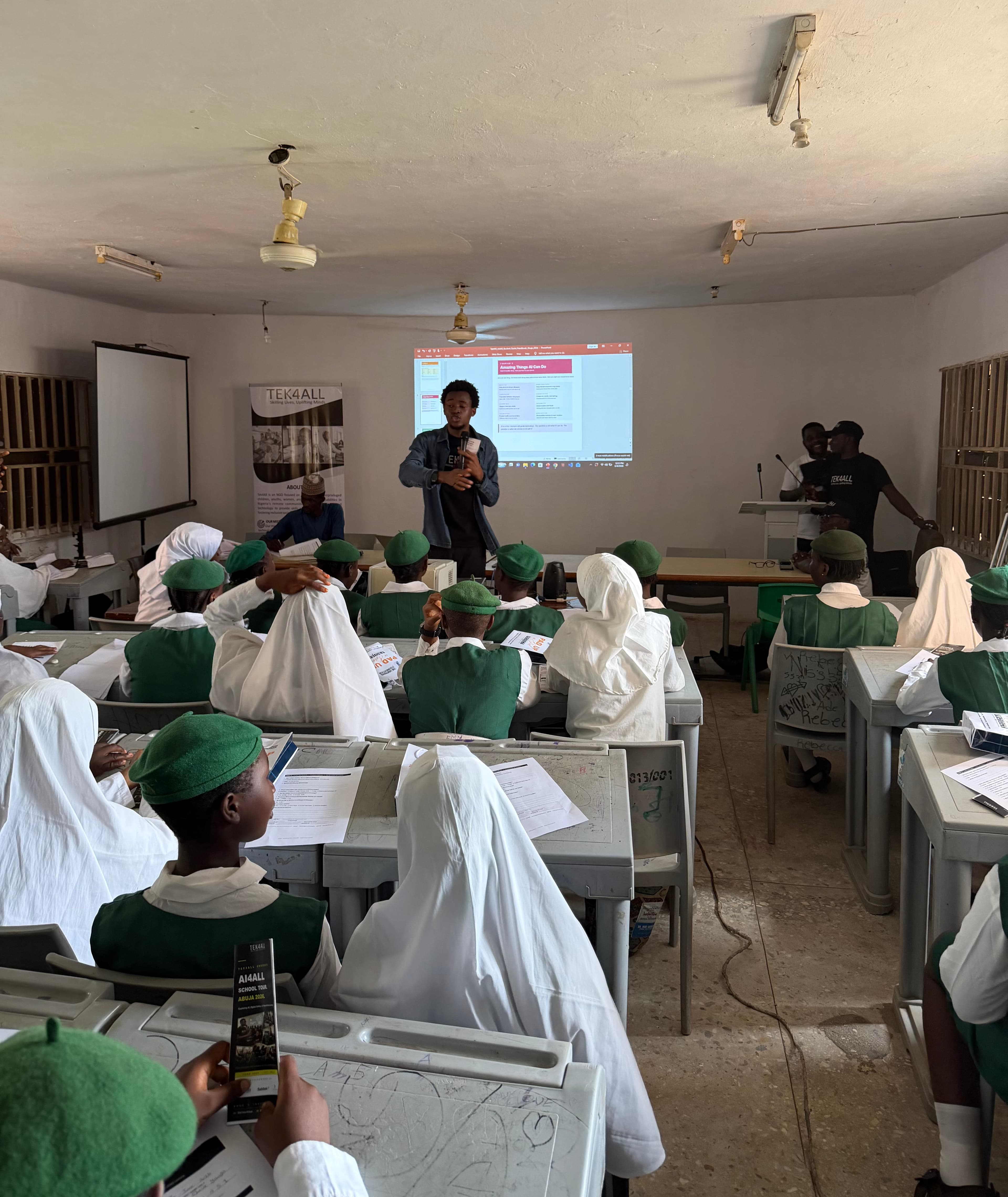
A girl in the back row of a classroom in Bako raised her hand and asked whether AI could one day teach her younger brother how to fix mobile phone better. She was fifteen. She had not used ChatGPT. She did not own a smartphone. She had heard the term "AI" exactly twice before that morning. And she had already understood, in a way that took policy makers a decade, that the technology shaping the future was either going to lift her family or leave them behind.
That is the moment the AI4All School Tour exists for.
When Tek4All started this tour, we were not chasing impressions. We were chasing rooms full of students like that girl, students in underserved public schools who are routinely treated as the last to know. We were not going to let the future arrive at private schools and global conferences while government school students learned about AI from rumour, headlines, and TikTok. We wanted them to see it, question it, understand it, and imagine themselves inside it.
We started at Government Girls Secondary School, Abaji. From there we moved to Government Girls Secondary School, Dutse, and then to Government Secondary School, Bako. Three schools in, and the same thing keeps repeating itself: the hunger to learn is real. The curiosity is real. The potential is real. What is missing is not intelligence, ambition, or interest. What is missing is access.
Across these three schools we have reached hundreds of students and teachers, with over 300 girls engaged so far. We have collected about 380 student and teacher baseline surveys and post-event assessments. Those forms are doing real work for us. They tell us what students already know about AI, what teachers are seeing in their classrooms, where the gaps are, and what kind of support a public school in Abuja actually needs in 2026.
The responses keep surprising us, then making sense.
Students lit up when they realised AI was not a robot from a film. They connected it instantly to things they already use every day: YouTube recommendations, TikTok feeds, Google Search, the camera on a borrowed phone, voice assistants, fraud alerts from their parents' banks. The session did not introduce AI to them. It named something they had already been living with. Once it had a name, it had a future they could plan around.
Their excitement also exposed something harder.
Some students told us, plainly, that they do not have a device. Others said the internet is something that visits the school, not something that lives in it. A few had heard of AI tools but had never used one. Others had seen AI online but had no idea how to use it for learning, creativity, problem solving, or career planning. None of these are small gaps. They are the early outline of a divide that hardens every year a student waits.
The divide is not only between countries. It is not only between cities and villages. It is between private schools and underserved public schools. It is between students who get to practice with the future and students who are quietly expected to catch up to it later, alone, with whatever they can find. If we do nothing, AI becomes another inheritance the wrong children get.
This is what the AI4All School Tour is fighting.
It is not a school visit. It is not a talk. It is not a photo wall. It is a deliberate intervention at the awareness stage, the stage where confidence is built, curiosity is rewarded, and a fifteen year old girl decides whether technology is for her or for someone else.
The benefits are already showing. Students are asking better questions. Teachers are starting to think about AI as something they can use in lesson planning, not as something to be afraid of. Schools are leaning into structured conversations about digital safety. Girls are picturing themselves in careers in AI, cybersecurity, robotics, digital design, data, health tech, agricultural technology, and software. Most of all, students are starting to understand that AI is a tool they can learn, use responsibly, and shape for good.
At every school, we identify AI Champions. These are students who showed up with curiosity, confidence, a willingness to lead, and a readiness to keep learning after we leave. Across the first three schools we now have over 30 AI Champions. They are not the students who already know everything. They are the students who want to know. They will be mentored to become peer leaders in their schools and communities, the bridge between one session in a hall and a culture of learning that lasts.
The vision is small and powerful. A student who learns today can teach another student tomorrow. An AI Champion can start a conversation in her classroom. She can help a friend understand digital safety. She can encourage responsible use of AI tools. She can hold an AI club together. One assembly becomes a club. One club becomes a school. One school becomes a movement.
That continuity is where SabiTek comes in.
One session is not enough, and we know it. Awareness has to become learning. Learning has to become practice. Practice has to become confidence. Through SabiTek, students get a pathway to keep going after the tour leaves the gate: beginner friendly lessons, AI learning resources, challenges to try at home, and a route to future mentorship. The AI4All School Tour is the spark. SabiTek is the fire we keep lit.
The data we are gathering is doing something else too. Every survey, every conversation, every show of hands is building real evidence about what AI awareness, digital safety knowledge, and access actually look like inside Nigerian public secondary schools right now. When we walk into a partner meeting or a sponsor's office, we will not be carrying assumptions. We will be carrying answers from the students themselves.
The first three schools have reminded us of something the policy world keeps forgetting. Young people do not need to be persuaded that the future matters. They already know. What they need is access, guidance, tools, encouragement, and people who show up for them early enough to make a difference.
At GGSS Abaji, GGSS Dutse, and GSS Bako, we did not see students who were afraid of the future. We saw students who wanted to take it apart and put it back together. We saw girls raising their hands, asking questions, and imagining careers their grandmothers could not have named. We saw teachers leaning forward. We saw schools welcoming a conversation that is becoming urgent for every learner in this country.
And we are not done.
The tour continues. More schools are coming. One classroom at a time, one girl at a time, one champion at a time, Tek4All is closing the AI awareness gap, deepening digital safety knowledge, and building a generation of students who will not just consume technology but use it, question it, and build with it.
Because the future of AI should not belong only to students with newer devices, faster internet, or richer classrooms.
It should belong to every curious child.
It should belong to every girl who has been told technology is not for her.
It should belong to every public school student who deserves the confidence to say:
"I can learn this."
"I can use this."
"I can build with this."
"I can lead in this future."
This is why we started.
This is why we will keep going.
AI4All School Tour Abuja 2026
Bridging the digital divide with responsible AI.
Tek4All. Skilling Lives. Uplifting Minds.