Africa Does Not Need Another Course Marketplace. It Needs Infrastructure.
There are roughly 250 million school-age children in Africa today. By 2030, that number will be closer to 300 million. UNESCO estimates the continent will need an additional 17 million teachers to meet basic education targets by then. Meanwhile, the institutions that are doing the most to bridge that gap, the NGOs, the training centres, the government skills programs, the verified instructors running real curricula, are running their entire operations on tools that were not designed for them. WhatsApp groups for cohort communication. Excel sheets for attendance. Free Google Forms for assessments. Email chains for reporting. Drive folders nobody can find anything in.
This is not a complaint. It is a description of the actual conditions under which African education infrastructure operates today. The teachers are extraordinary. The learners are hungry. The funding, when it comes, is real. What is missing is the layer underneath, the boring, essential thing that makes the rest of it possible to scale.
That is what Sabitek is.
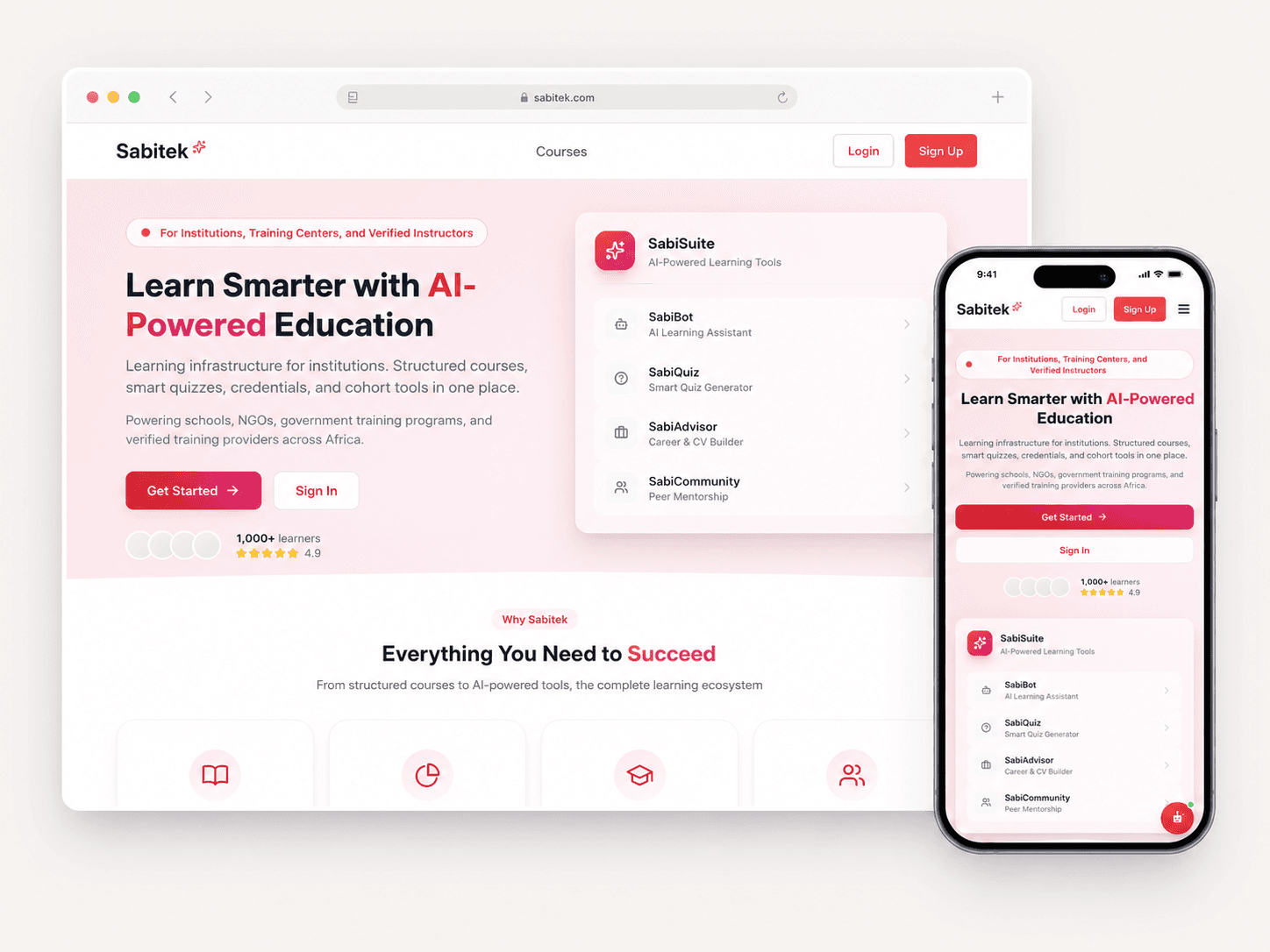
Sabitek is a learning management system built specifically for African institutions. Not adapted from a Silicon Valley product. Not retrofitted from a marketplace. Designed from the first commit for the way schools, NGOs, training centres, and verified instructors on this continent actually run learning programs. We use it ourselves. Tek4Teachers cohort three is running on Sabitek as you read this, with full attendance tracking, assessment delivery, certificate issuance, and donor reporting flowing through one platform instead of seven. NextGen Innovators launches on it next. Women-in-Tek follows. AI4All School Tours runs on it before the school year ends. By the time those four programs complete, twenty other institutions, schools, NGOs, training programs, and one government agency, will be onboarded.
Here is what makes Sabitek different, in concrete terms.
Sabitek is a workspace, not a marketplace. When an institution requests access and gets verified, they receive a private corner of the platform that is theirs. Their learners, their programs, their data, their reporting. No public signup form for learners to wander in from a Google search. No other institution's learners showing up in their dashboard. No marketplace dynamics distorting what they paid for. This is the single most important design decision in the entire platform, and the one most LMS products refuse to make because it slows growth metrics. We made it deliberately. African institutions told us repeatedly, in conversations stretching across months, that they would not put their learner data into a system where the platform was the primary tenant and they were the guests. So we built it the other way around.
Sabitek adapts to the institution, not the other way around. A primary school administrator logs in and sees curricula, classes, subjects, and pupils. An NGO program officer logs into the same Sabitek and sees programs, cohorts, and beneficiaries. A vocational training centre sees tracks, batches, and credentials. A corporate L&D team sees learning paths, employees, and competencies. Same underlying engine. Different vocabulary, different dashboards, different KPIs surfaced on each screen. We built this because we got tired of watching organisations contort their language to match someone else's software. The terminology pack and KPI pack systems mean a school never has to call its students "cohort members," and an NGO never has to call its beneficiaries "users."
Sabitek runs where Africa actually runs. The platform is built mobile-first because the majority of African learners reach it through phones, not laptops. Pages load on 3G. Forms work on 2G if they have to. We are mid-development on a progressive web app layer with offline support, which means a learner in a community with intermittent connectivity can download a lesson, work through it offline, and sync progress when signal returns. This is not a feature we are adding for thoroughness. It is the difference between a program reaching its full cohort and losing 30 percent of learners to "couldn't load the page." Anyone building education infrastructure for this continent who is not solving for low-bandwidth conditions is solving a different problem than the one most learners actually face.
Sabitek covers the entire arc, not just the teaching. Most LMS platforms handle content delivery and stop. Sabitek handles content delivery, but also enrollment (CSV bulk invite, shareable links, QR codes, email domain allowlists), structured assessment (with SabiQuiz generating quizzes from your uploaded materials in seconds), progress tracking per learner per cohort, payments where applicable (wallet balances, Paystack integration, NGN-first), verifiable certificates with QR-based public verification, and the reporting layer that lets you defend your numbers to donors, regulators, and boards. The reason this matters is that an institution running a real program does not need a tool for one stage; they need infrastructure across the entire lifecycle, and the cost of stitching seven products together is what burns out program managers.
Sabitek has an AI suite that earns its place. Five tools, each solving a specific problem we hit in our own programs before we ever thought of offering them to others. SabiBot is a learning assistant that speaks English, Pidgin, Yoruba, Hausa, and Igbo, available to learners when their facilitator is asleep at 11pm and the question cannot wait. SabiQuiz generates assessments from PDF course materials, saving facilitators entire weekends of work. SabiAdvisor turns "completed the program" into "got the job" with a CV builder, cover letter builder, ATS scoring against real job descriptions, and interview preparation drills. SabiWrite is a writing assistant calibrated for African English and African contexts. SabiCommunity connects learners to peer mentors who are three steps ahead of them, because the most powerful learning support is often someone who recently walked the same path. None of these replace teachers. All of them multiply what one teacher can do.
Sabitek issues credentials that survive scrutiny. Every certificate Sabitek produces carries a QR code that resolves to a public verification page. An employer scans it and sees who issued it, when, to whom, which program, what was covered. This matters more every year as employers get more careful about what they trust and as African talent moves into roles where credentials are scrutinised by international hiring systems. The certificate is no longer a piece of paper; it is a verifiable claim backed by an institution with a verifiable identity.
We use Sabitek because we built Sabitek for ourselves first. Tek4All has been running cohort-based digital skills programs across Nigeria for years through Tek4Teachers, Women-in-Tek, AI4All, and NextGen Innovators. We tried the international LMS platforms. We tried the marketplaces. We tried building custom things on top of Google Workspace. Every option made us conform to its assumptions, and its assumptions were not African. So we built the platform we wished existed. The current generation of Tek4Teachers facilitators report saving roughly half a day per week on administrative work they used to do by hand. The next cohorts, NextGen, Women-in-Tek, AI4All, will run entirely on Sabitek from day one.
The twenty institutions onboarding next came to us. Not through ads. Not through a marketing funnel. Through conversations with people who watched us run our own programs on the platform and asked if they could use it too. Schools modernising their digital curriculum delivery. NGOs running structured skills programs across multiple states. Training centres preparing learners for ICT certifications. One state government's training arm. Each one is a real organisation with real learners and real outcomes to track, and each one is the kind of institution Sabitek was built to serve.
What is shipping today: full workspace provisioning, programs, cohorts, lessons, quizzes, certificates, payments, the entire AI suite, vertical adaptation for different institution types, application review for new workspaces, auto-provisioning of admins, bulk invite, domain allowlists, dashboards, audit logs.
What is in active development right now: course-institution scoping so each institution can build their private course catalogue, followed by the matching learner-side experience that surfaces each learner's specific cohort content cleanly.
What is on the near horizon: full progressive web app with offline support, multi-language UI in Nigerian languages, deeper analytics dashboards, and a mobile native app for institutions whose learners prefer it.
If you run an institution in Africa and you are tired of stitching together tools that were never designed for the work you do, you can request a workspace at sabitek.school/request-access. Tell us about your program. We will tell you whether Sabitek fits and when you can be onboarded.
The work that matters happens in the classrooms, the training rooms, the NGO field offices, the corporate L&D sessions, the village community centres where someone is teaching someone else something that will change their economic future. We are building the thing underneath, so that work can finally scale.